
June Birthstone Jewelry: Pearl, Moonstone or Alexandrite?
June has three birthstones: pearl, moonstone and alexandrite. Choose pearl for luster and texture, moonstone for a shifting sheen, or alexandrite for a change of color between light sources. For a frequently worn ring, alexandrite is generally the more durable candidate of the three. That is a conditional comparison: the wearer’s taste, budget, setting and care routine still decide which piece makes sense.
A June gift does not need to be the rarest option. GIA recognizes all three stones, giving you different ways to match the birthday connection to someone’s everyday style. This guide compares the looks, the practical wear choices and the limits of online identification.
How do pearl, moonstone and alexandrite look different?
Pearl offers luster across a surface that may be round, softly irregular or distinctly baroque. A row of small pearls and one sculptural centerpiece create different impressions, even before color enters the choice.
Moonstone is known for adularescence: a sheen that appears to move across the gem as the viewing angle changes. Alexandrite changes color under different light sources. Turning a stone and changing its illumination are different observations, so ask what a product video is showing.
GIA’s June guide describes these optical qualities. They can help you choose an appearance, but a glow or color change does not independently prove a material’s identity. Another gemstone or a manufactured imitation may show an effect that looks convincing in a short clip.
Which look fits the person receiving the gift?
Start with a piece they already wear and ask what they enjoy about it. Is it a familiar soft highlight near the face, an unusual detail they like to examine, or a stronger change of color? These preferences are more useful than assigning personalities to gemstones.
For a pearl example, the Muse Pearl Necklace pairs seed pearls with a baroque centerpiece. Its listed 40 cm option gives you a length to compare with the wearer’s preference. Our pearl necklace buying guide looks more closely at luster, shape and fit.
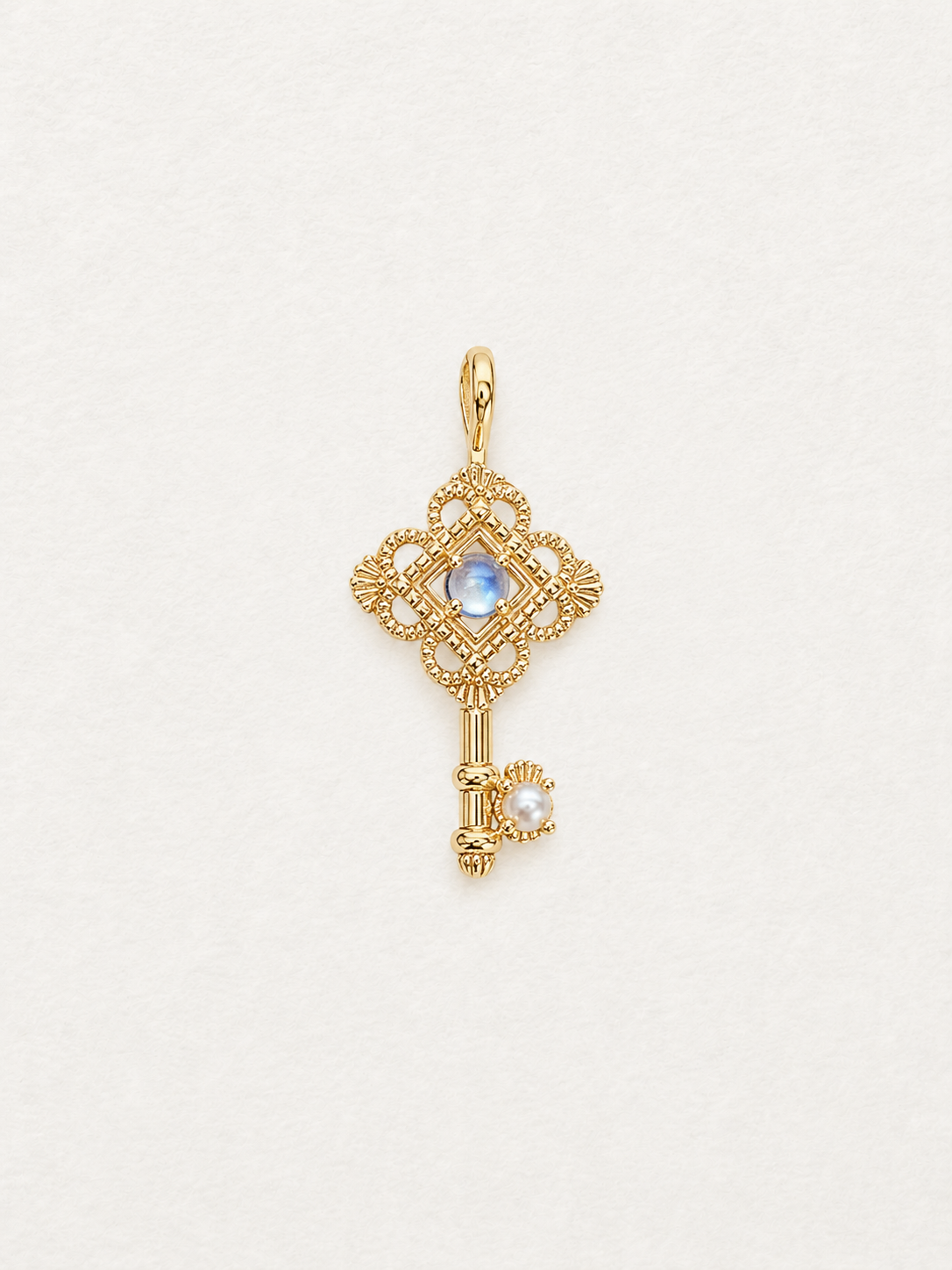
The Lace Blue Moonstone Pendant offers a different direction, with an oval moonstone, gold-toned filigree and white zircon accents. Check its current dimensions and chain options before deciding. A pendant is not automatically a complete necklace, and a close-up is not a scale drawing.
Those examples represent materials in our current June selection. It does not currently include an alexandrite piece. Alexandrite is discussed here to make the month’s comparison complete.
Which is practical for frequent wear with less maintenance?
GIA describes alexandrite as hardness 8.5, with excellent toughness and no cleavage. Those properties make it a strong candidate for rings, while the setting and any treatment still require attention. “More durable” does not mean maintenance-free or suitable for every activity.
Moonstone is softer, at 6–6.5, and has poor toughness with cleavage. A hard impact can break it. A pendant or earrings may be easier to accommodate than a ring for someone whose hands are busy throughout the day. GIA advises against ultrasonic and steam cleaning moonstone.
Pearls are much softer, approximately 2.5–3 on the Mohs scale. GIA recommends wiping them after wear and protecting them from cosmetics, chemicals and abrasion. Never put pearls in ultrasonic or steam cleaners. Their luster can be worth the extra attention if the wearer enjoys the routine.
For a mixed-material design, use the care requirements of the complete piece. A harder accent stone does not make a pearl strand or plated setting less delicate. Follow our care guide and the product instructions. The pearl necklace care article covers cleaning and storage in more detail.
How do natural alexandrite, laboratory-grown alexandrite and look-alikes differ?
Alexandrite is a color-change variety of chrysoberyl. Natural material formed in the earth; laboratory-grown alexandrite is produced through a laboratory process. A look-alike is another material that resembles it. “Color-change” by itself does not identify which you are being offered.
GIA’s buyer’s guide explains that a description such as “alexandrite sapphire” commonly refers to color-change laboratory-grown sapphire, rather than alexandrite. Read the full name and ask the seller to resolve ambiguous wording before comparing prices.
A very clean appearance does not prove laboratory origin, and visible inclusions do not prove natural origin. For a significant purchase, independent gemological documentation can address identity and origin. Do not pay for a natural-origin claim on the strength of a photograph or a dramatic color-change demonstration alone.
What can photos and a laboratory report establish?
Ask for useful visual evidence, then keep its limits clear. For moonstone, a video can show how the sheen changes with angle. For alexandrite, ask for views under daylight and incandescent illumination with the light sources identified. Camera settings and screens can affect the colors you see, so a video helps with expectations rather than guaranteeing an exact match.
For a reported alexandrite, compare the report number, weight, dimensions and description with the stone. GIA states that its relevant reports can address natural or laboratory-grown identity and detectable treatments; geographic-origin opinions depend on the service and whether a conclusion is possible. A report is not a guarantee of value or workmanship.
For pearls, ask whether they are natural or cultured and whether treatments are known. Cultured pearls are genuine pearls, but “cultured” and “natural” describe different formation circumstances. Our pearl types and labels guide explains the terminology.
June birthstone questions
Which June stone is best for an everyday ring?
Alexandrite is generally the strongest durability candidate among the three, but the actual stone, setting, budget and wearer’s routine still matter.
Are cultured pearls suitable for a June birthday?
Yes. They are a genuine pearl option and should be described accurately as cultured.
Does a strong color change prove natural alexandrite?
No. Laboratory-grown material and other color-change gems can show convincing effects. Identity and origin may require professional testing.
What if I do not know the recipient’s size?
Choose a format they already enjoy and confirm its measurements. Our size guide can help; review current delivery and return terms before ordering. For more context, see the June birthstone overview.